
Standing at the historic juncture of 2026, China’s dental industry is experiencing a profound paradigm shift. The era of driving massive growth through information asymmetry and premium pricing is drawing to a close. Powered by strict regulatory shifts, AI integration, and the rise of robust domestic supply chains, the Chinese dental market is evolving from a fragmented "growth-at-all-costs" arena into a compliant, value-driven trillion-RMB ecosystem.
For international distributors, dental brands, and industry observers, understanding this transformation is equivalent to unlocking the code for the next decade of global dental supply chains.
Here is how three powerful forces are rewriting the logic of the world’s largest dental consumer market.
1. The Gen Z Paradox: Balancing Financial Prudence with Cosmetic Dentistry
 The primary driver of this market shift is the generational transition to Gen Z (born 1995–2009). As digital natives, their behaviors are reshaping dental clinical models in two distinct ways:
-
The Cost Barrier & Preventative Shift: Despite a strong global awareness of the link between oral health and systemic well-being, Gen Z faces substantial economic pressures. Entering the workforce during periods of economic volatility, they are highly sensitive to financial risk. In response, they are shifting the clinical focus from costly, late-stage treatments to early preventative care (e.g., routine scaling, periodontics), viewing oral hygiene as an integral part of long-term health management.
-
The Rise of Esthetic Dentistry: Conversely, Gen Z is highly driven by emotional and social value. Social media comparison has turned dental treatments into a form of confidence investment. Demand for clear aligners and dental veneers has spiked significantly.
 They visit clinics not because they are in pain, but because they seek self-presentation and identity reinforcement.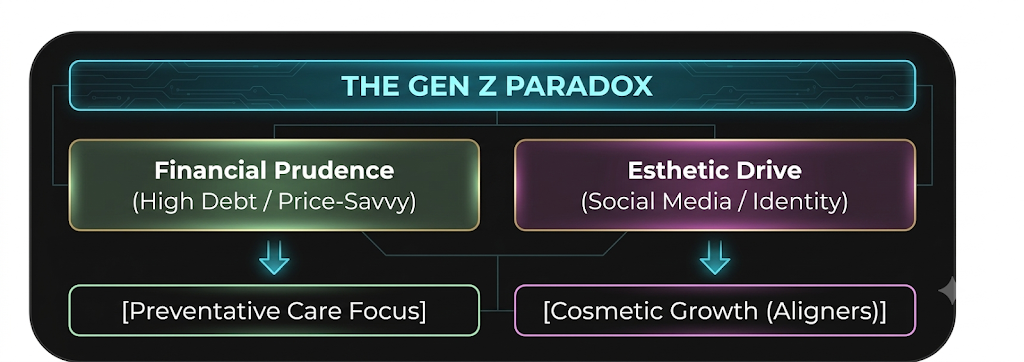
2. The Regulatory Turn: From Premium Monopoly to Value-Driven Procurement
If consumer demand is the engine, policy change is the steering wheel. The implementation of government-led Volume-Based Procurement (VBP) has drastically flattened the pricing structure of dental consumables—most notably premium implant systems, which have seen massive price corrections into accessible tiers.
This regulatory intervention is not merely a price war; it is a structural purge. Lower-tier clinics relying purely on high-margin material markups are being phased out rapidly. Conversely, compliant, high-efficiency institutions are capturing the massive volume of middle-class clinical demand. The industry consensus has shifted: value is no longer found in selling expensive components, but in delivering comprehensive, life-cycle oral health management.
3. Tech-Driven Productivity: AI, 3D Printing, and Chairside Innovations
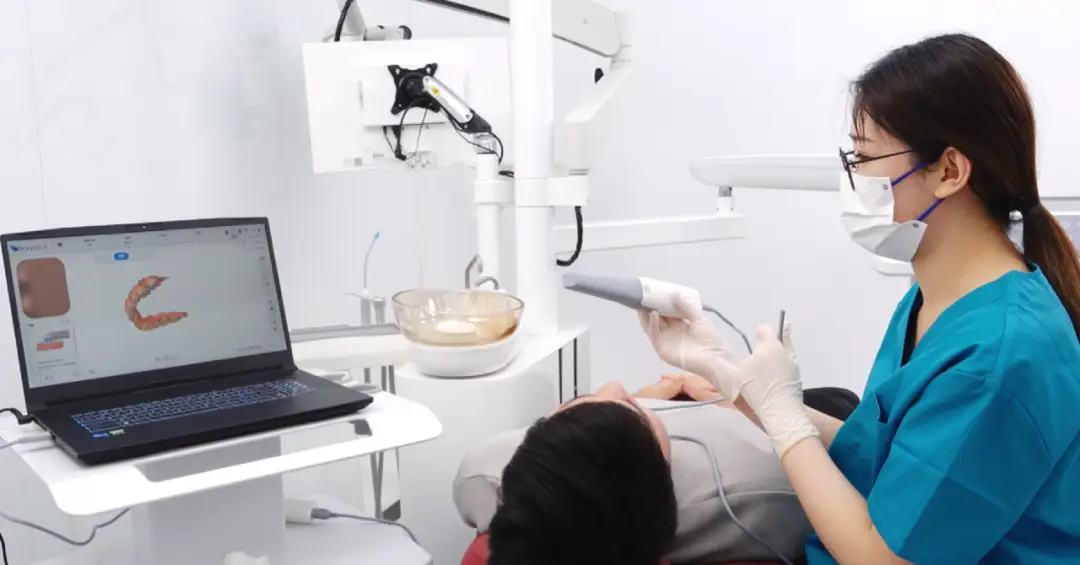
To maintain healthy margins under a more standardized pricing structure, the industry has turned to AI and digitalization as its core productivity engine.
Furthermore, the introduction of 5G-powered mobile smart clinics and specialized dental Large Language Models (LLMs) has enabled top-tier medical expertise to decentralize, offering standardized, high-quality triage and diagnostics even in remote regional areas.
4. Supply Chain Resilience: The Acceleration of High-Quality Localization
On the industrial side, recent global supply disruptions have triggered a major shift toward supply chain independence. Chinese manufacturing has moved far beyond low-cost replication, achieving vertical integration across high-tech dental material sectors.
Key Industrial Milestones:
-
Advanced Material Mastery: Leading Chinese nano-material enterprises have secured the entire production loop—from raw zirconia powder to formulated blocks and finished crowns—mitigating global supply chain vulnerabilities.
-
Manufacturing Automation: Advanced digital dental manufacturing hubs have reduced traditional 28-step prosthetic workflows down to just 5 steps via automated milling and additive manufacturing, slashing delivery turnarounds to 48 hours.
For international buyers and "House Brand" private-label owners, this industrial maturity offers an ideal intersection of quality, safety, and cost-efficiency. Choosing modern localized materials is no longer just a budget decision—it is a strategic choice for supply chain security and premium engineering.
Conclusion: Embracing the Era of Dental Long-Termism
The transformation witnessed in 2026 marks the maturity of China's dental ecosystem. By shedding its historic reliance on high markups and embracing regulatory compliance, digital precision, and resilient manufacturing, the industry is entering its most sustainable growth phase yet.
For global dental professionals, the lesson is clear: the future belongs to those who invest in technology, prioritize transparent, preventative patient value, and align with highly integrated, modern supply chains.